Earthquake sequences
Aftershocks, foreshocks and mainshocks
If you have just felt an earthquake, expect more shaking. Aftershocks are how the ground settles after a rupture — here is how long they last, how big they get and how far they reach.
Aftershocks are near-certain after a significant earthquake and are most frequent in the first hours. Most are smaller than the mainshock, but a larger one is always possible. Below magnitude 6 the sequence is usually over in days to weeks; a magnitude 7 keeps going for months to years. Stay out of damaged buildings and follow local emergency instructions.
What is an aftershock?
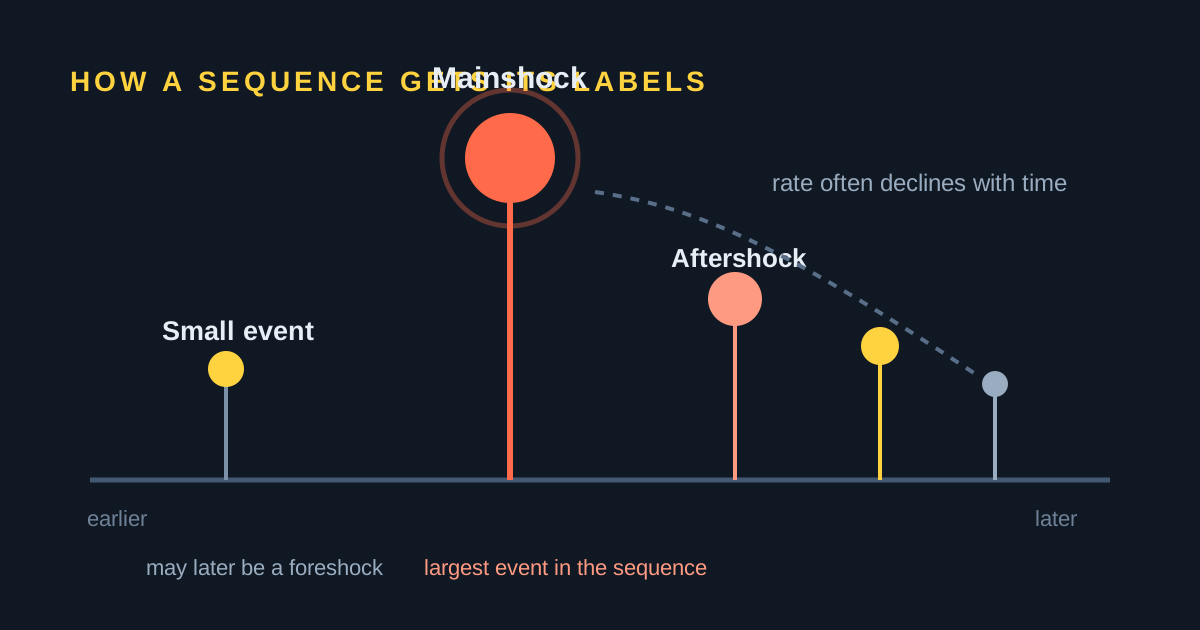
An aftershock is an earthquake that follows a larger one in roughly the same place. The mainshock releases stress on the patch of fault that slipped and loads the rock around it, and the surrounding crust then adjusts in a long series of smaller ruptures. Nothing is physically different about an aftershock; it is an ordinary earthquake, defined entirely by what came before it.
That still matters after a damaging event, because aftershocks arrive at buildings that are already cracked and ground that may already have slumped. A magnitude 5 is a modest earthquake in a normal week and a serious hazard the day after a magnitude 7.
Foreshock vs aftershock: labels that can change
The three words describe an event's position in a sequence, not its mechanism. The only thing separating a foreshock from an aftershock is which side of the largest event it falls on.
- When it happens: an earthquake is simply an earthquake. Nothing measurable at the time reveals that it will turn out to be a foreshock.
- Largest event so far: the biggest earthquake in the sequence is the mainshock.
- Everything after: smaller nearby events, while activity decays toward the normal background rate, are aftershocks.
If a bigger earthquake then strikes the same area, the labels are rewritten and the old “mainshock” becomes a foreshock. That is a change of context, not a mistake in the earlier measurement.
How long do aftershocks last?
Aftershock sequences decay in a consistent way, described since the 1890s by Omori's law: the number of aftershocks per day falls roughly in proportion to one divided by the time since the mainshock. Day two brings about half as many as day one, day ten about a tenth, day one hundred about a hundredth — a steep initial drop followed by a long, thin tail rather than a clean ending.
Read that as a shape, not a schedule. Real sequences are lumpy: a quiet week can be followed by a burst, and a large aftershock can start a small sequence of its own. The decay rate varies by region, which is why official forecasts are fitted to each sequence rather than assumed.
Because the decay is so slow, the total duration depends mostly on the size of the mainshock — a bigger earthquake starts from a much higher rate, so it takes far longer to fade into the background.
| Mainshock size | Typical sequence length |
|---|---|
| Below magnitude 6 | Days to a few weeks, mostly in the first day or two |
| Magnitude 6 to 7 | Weeks to months, with occasional events for a year |
| Magnitude 7 and above | Months to years; damaging aftershocks stay possible |
| The greatest earthquakes | Decades — events are attributed to the sequence a generation later |
These are orders of magnitude, not promises. A USGS study of the 2018 magnitude 7.0 Anchorage earthquake in Alaska put the time needed to decay back to the pre-earthquake rate at between about two and a half years and three decades — a spread of more than ten to one for one well-recorded event. And the magnitude 9.1 Tōhoku-oki earthquake of 2011 is still producing them: large earthquakes off the Pacific coast of Japan a decade later fell inside the 2011 rupture zone and are treated as part of that sequence.
Can an aftershock be bigger than the mainshock?
It can — and if it is, the naming changes rather than the physics. On average, though, the biggest aftershock lands well below. Båth's law, a rule of thumb from the 1960s, places the largest aftershock roughly 1.1 to 1.2 magnitude units below the mainshock, more or less regardless of how big the mainshock was. A magnitude 7 therefore tends to produce a largest aftershock near magnitude 5.8 to 5.9, and a magnitude 8 one near 6.8 to 6.9.
The critical word is average: a central tendency across many sequences, not a ceiling any single sequence has to respect. Some mainshocks produce a largest aftershock far below it, and a few produce one so close in size that seismologists describe it as a separate, triggered earthquake instead.
How far do aftershocks spread?
Aftershocks fill the patch of fault that broke and spill roughly one to two fault lengths beyond it, so the aftershock zone is about as large as the rupture. A magnitude 4 breaks a few hundred metres of fault and its aftershocks sit almost on the epicentre; a great earthquake ruptures hundreds of kilometres and scatters aftershocks over a comparable distance. That is why an aftershock can be felt strongly in a town that barely noticed the mainshock: the epicentre is a point, but the rupture is a surface.
Three sequences worth knowing
Ridgecrest, California, 2019. A magnitude 6.4 struck on 4 July 2019 and was treated as the mainshock of its own sequence. About 34 hours later a magnitude 7.1 broke an adjacent fault in the same area: the 6.4 was reclassified as a foreshock and the 7.1 became the mainshock. It is the textbook case of a label applied with hindsight, and both events sit on the California earthquake map.
Kahramanmaraş, Türkiye, 2023. The magnitude 7.8 Pazarcık earthquake of 6 February 2023 was followed about nine hours later by a magnitude 7.5 roughly 90 km to the north. Barely 0.3 magnitude units separate them — far closer than Båth's law suggests — and the second broke a different fault, so it is usually called a triggered second mainshock. Together the ruptures produced more than 500 km of surface breakage; later activity appears on the Türkiye earthquake map.
Santa Fe and Atarfe, Granada, Spain, 2020–21. A long, shallow series shook the villages west of Granada from December 2020. Spain's Instituto Geográfico Nacional had located more than 3,000 events there by August 2021, 36 of magnitude 3.0 or above, the largest magnitude 4.4 with a maximum intensity of V–VI at Atarfe. It had no dominant mainshock, which makes it a swarm — see the Granada earthquake map.
Swarms are not mainshock–aftershock sequences
In a swarm, many earthquakes of similar size occur in one small area over days or weeks with no event that stands out as the mainshock. The rate does not simply decay: it can pause, restart and peak more than once. With no mainshock, neither Omori's law nor Båth's law describes it, and the intuition that “the worst is over” after the biggest shock does not apply.
Swarms are especially common in volcanic settings, where magma breaks rock as it forces a path upward. Two well-documented examples fall in the same year:
- Reykjanes Peninsula, Iceland (2021). An intense swarm ran for about a month — including a magnitude 5.6 in late February — as a dyke propagated near Fagradalsfjall, and the eruption began on 19 March. Icelandic seismicity has been dominated by this pattern since.
- Cumbre Vieja, La Palma, Spain (2021). A swarm that began on 11 September escalated over eight days before the eruption started on 19 September.
Swarms also occur without volcanoes: the Granada series is tectonic, and injection-related swarms are common in Oklahoma.
Official aftershock forecasts
After a significant earthquake the USGS publishes an operational aftershock forecast on the event's own page. It is statistical and updated as the sequence develops: the model starts from a generic regional rate and moves toward how this particular sequence is actually behaving.
A forecast gives probabilities and likely counts across four windows — the next day, week, month and year — for several magnitude thresholds, typically magnitude 3 and above, 5 and above, and 6 or 7 and above. In shape it reads as “a probability of one or more magnitude X or larger in the next week”, alongside how many smaller felt aftershocks to expect. It never names a date, place and size for a specific future earthquake, and a probability is not a promise in either direction.
Can a cluster reveal the next large earthquake?
No. Most small earthquakes and most clusters are not followed by anything larger, and “foreshock” is only ever assigned after the fact.
What would count as a prediction, which proposed precursors have been tested and failed, and what long-term forecasting genuinely delivers are covered in our guide to whether earthquakes can be predicted.
What to do after a strong earthquake
- Expect aftershocks and be ready to drop, cover and hold on again. The first hours carry the highest rate, and you may get no warning at all.
- Stay out of damaged buildings. Structures weakened by the mainshock are what aftershocks bring down.
- If you are near the coast and the shaking was long or violent, move inland and uphill without waiting for an official tsunami message.
- Check for hazards where you are: gas smells, damaged wiring, broken glass, unstable shelving and loosened slopes above or below you.
- Follow your local emergency authority on evacuation, shelter and re-entry. A live earthquake map is for awareness, not instruction.
- Use text or messaging rather than voice calls so networks stay clear, and let your contacts know you are safe.
Following a sequence on SeismoWatch
The seven-day earthquake map makes clusters visible, and the regional maps show what an area normally does — a cluster only means something once you know the baseline. Catalogues also carry unrelated background events, and magnitudes, depths and locations are revised as analysts review them.
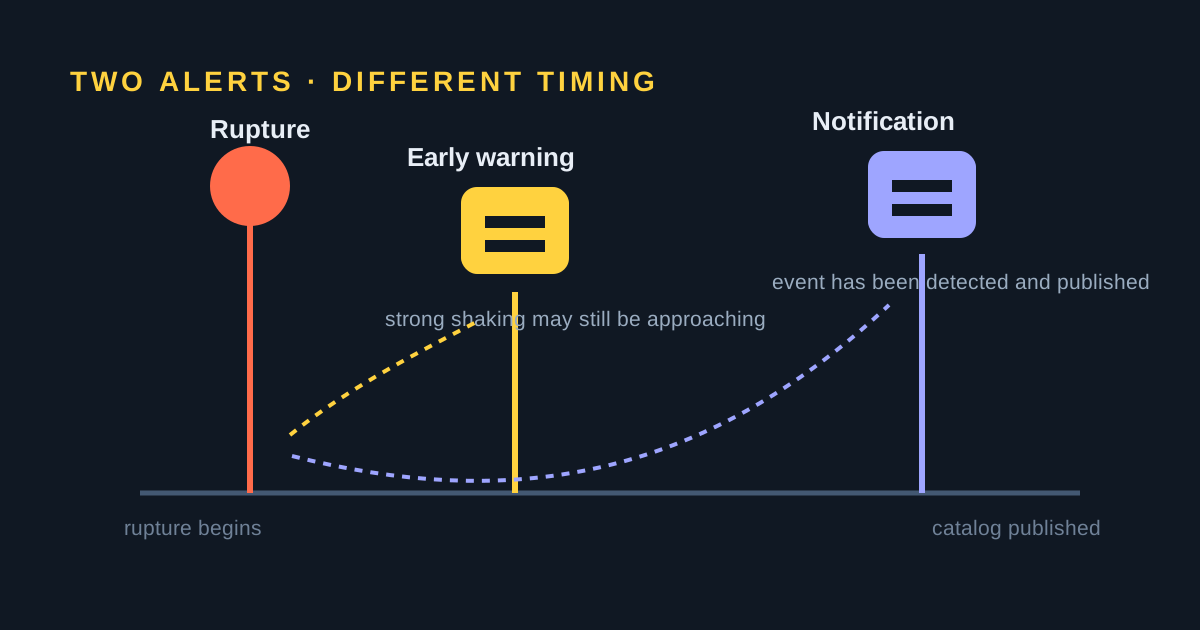
SeismoWatch notifies you about earthquakes already published by USGS, EMSC and FUNVISIS, filtered to the area and magnitude you choose. It is a monitoring tool, not an early-warning system. Set up alerts to follow a sequence, and keep your government emergency alerts switched on regardless.
Frequently asked questions
How long do aftershocks last?
It depends on the size of the mainshock. Below about magnitude 6 the sequence is usually over in days to weeks. After a magnitude 7 it can run for months to years, and after the very largest earthquakes seismologists still identify aftershocks decades later. In every case the rate is highest in the first hours.
Can an aftershock be larger than the mainshock?
Yes. When it happens the labels change: the larger event becomes the mainshock and the earlier one a foreshock. On average the largest aftershock is about 1.1 to 1.2 magnitude units below the mainshock, so a magnitude 7 usually produces a largest aftershock near 5.8 to 5.9 — an average, not a ceiling.
How far from the epicenter do aftershocks happen?
They fill the area that ruptured and spread roughly one to two fault lengths beyond it. A small earthquake breaks a short stretch of fault, so its aftershocks stay close; a great earthquake can rupture hundreds of kilometres and spread aftershocks over a matching area.
Are earthquake swarms the same as aftershocks?
No. A swarm has no single dominant earthquake: many events of similar size occur over days or weeks, and the rate can rise and fall instead of simply decaying. Swarms are common in volcanic areas, where moving magma is often the driver.
Do a lot of small earthquakes mean a big one is coming?
Usually not. Most small earthquakes and most swarms are not followed by anything larger, and an event is only known to have been a foreshock once a bigger one occurs nearby.
Is it safe to go back inside after a strong earthquake?
Not until the building has been checked. Aftershocks bring down structures the mainshock already weakened, so follow local emergency authorities and stay out of visibly damaged buildings until they are inspected.
Sources and further reading
- USGS: foreshocks, aftershocks — what's the difference?
- USGS: aftershock forecast overview
- USGS: the statistical model behind aftershock forecasts
- USGS event page: M7.1 Ridgecrest earthquake sequence, July 2019
- USGS story map: the 2023 Kahramanmaraş, Türkiye earthquake sequence
- USGS: potential duration of the 2018 Anchorage aftershock sequence
- USGS: what is an earthquake swarm?
- EMSC: European-Mediterranean Seismological Centre, the catalogue behind our Granada and Spain pages
- Ready.gov: what to do during and after an earthquake
- Earthquake Country Alliance: drop, cover and hold on