Prediction explained
Can earthquakes be predicted?
No scientifically reliable method can name the time, place and magnitude of a future earthquake. Several genuinely useful tools answer different questions — and it is worth knowing which is which.
No. Scientists can map long-term hazard, publish 30-year probabilities and forecast aftershock rates after a mainshock. Early-warning systems can detect a rupture seconds after it begins. None of these names a specific future earthquake, and no proposed precursor has ever passed a prospective test.
What would count as a prediction?
This is the test to apply to anything you are sent. A real prediction has to state all three of the following, narrowly enough to act on, and before the earthquake:
- Time: a window short enough that evacuating or shutting something down is a reasonable response — hours or days, not “this year”.
- Place: an area small enough to act in, not an entire plate boundary.
- Magnitude: a size range, so that any moderate earthquake in the region cannot be claimed as a hit.
A fourth requirement kills most claims outright: the method must be verifiable in advance and tested over many attempts, including its failures. “A major earthquake will strike the Pacific Rim soon” covers so much time and space that a match proves nothing. A prediction that is reworded after the event is not a prediction at all.
Prediction, forecast, probability and warning
| Term | What it provides | Is the earthquake already happening? |
|---|---|---|
| Prediction | Exact future time, place and magnitude | No—and currently not possible |
| Long-term probability | Chance of an event in a region over years or decades | No |
| Aftershock forecast | Probabilities and expected numbers after a mainshock | The mainshock has happened |
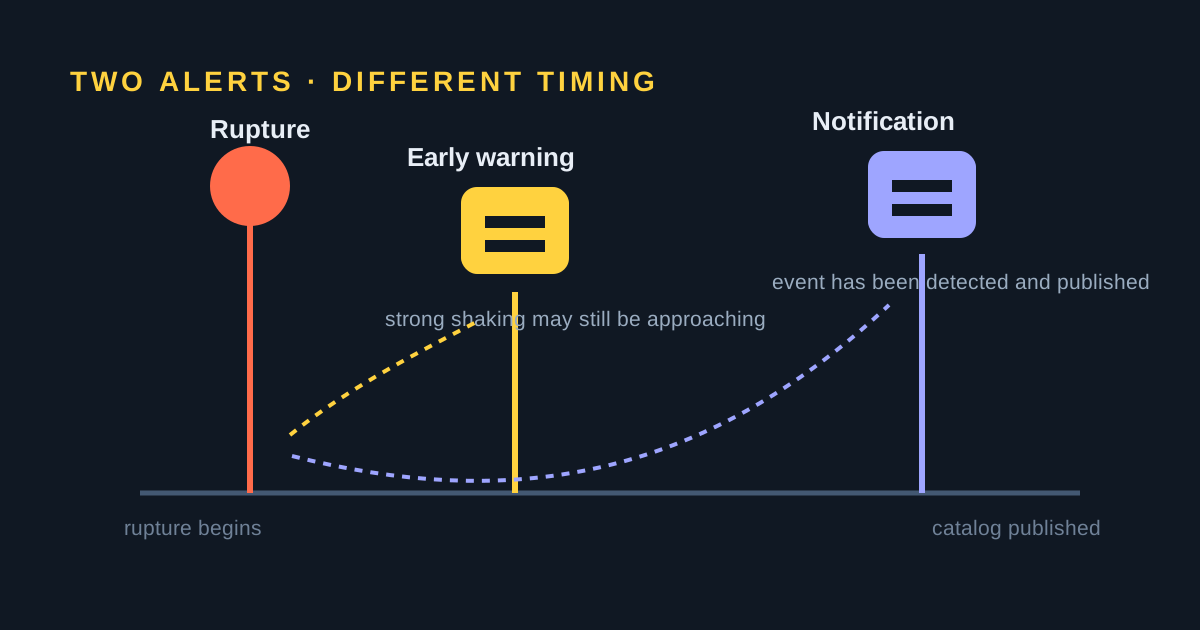
| Early warning | Seconds of notice that shaking may be approaching | Yes, rupture has begun |
| Notification | Details after an event is detected and published | Yes |
The four cases everyone cites
Haicheng, China, 1975. Officials ordered an evacuation in the hours before a large earthquake on 4 February 1975, and it is widely credited with saving lives. It is the closest thing to a successful prediction on record — but it rested on an unusually pronounced foreshock sequence, backed by reports of ground deformation, well-water changes and animal behaviour. That combination has never recurred in a way anyone could act on again.
Tangshan, China, 1976. Seventeen months later, a devastating earthquake struck Tangshan with no warning at all: no foreshock sequence, no evacuation. Official Chinese figures put the death toll above 240,000. Haicheng and Tangshan are always cited together, because together they show that the one apparent success was not a method.
Parkfield, California, 1985–2004. Moderate earthquakes had hit the Parkfield section of the San Andreas fault at fairly regular intervals — 1857, 1881, 1901, 1922, 1934 and 1966 — so in 1985 the USGS forecast the next magnitude 6 there before 1993, and instrumented the ground to catch it. The earthquake arrived on 28 September 2004, more than a decade late. The dense network made it the best-recorded earthquake of its kind; the schedule it was supposed to keep did not exist. Parkfield still appears in the California earthquake record.
L'Aquila, Italy, 2009. A magnitude 6.3 earthquake struck L'Aquila on 6 April 2009, killing more than 300 people. Weeks of small earthquakes had preceded it, along with an unofficial radon-based prediction that the authorities publicly dismissed. Six days before the earthquake an official stated that the seismic swarm meant a favourable situation because energy was being discharged — a claim with no scientific basis. Seven scientists and officials were convicted of manslaughter in 2012 over that risk communication; an appeals court overturned the scientists' convictions in 2014. The trial was never about failing to predict the earthquake, but it is the main reason “prediction” is now a word professionals use with extreme care. Later Italian seismicity is catalogued the same way as anywhere else.
Myths, and why each one fails the test
Earthquake weather
The idea that hot, still or oppressive weather precedes earthquakes goes back to antiquity. Weather affects only the first few metres of ground, while earthquakes begin kilometres down where surface conditions do not reach. It fails the test because no weather condition has ever been shown to precede earthquakes more often than chance — and because “muggy weather somewhere seismic” names no time, place or magnitude.
Moon phases and tides
This one is not pure fiction, which is why it persists. Earth and ocean tides genuinely raise and lower the confining pressure on shallow, dipping faults, and studies have found a small but real increase in the rate of some earthquakes at high tide. The USGS notes that the probability may rise by roughly a factor of three on those particular faults — but the background probability in a given place on a given day is so tiny that tripling it leaves it tiny. A full moon is not a warning, and “an earthquake is due at the next full moon” names no place and no size.
Planetary alignments
Posts claiming an alignment of planets will trigger a quake circulate every few months. The tidal pull of the planets at their distance is negligible next to that of the Moon and Sun, whose far larger effect is the tiny one described above. These claims also fail on their own terms: they name a date but no location or magnitude, so any earthquake anywhere in that week can be presented as confirmation.
Animal behaviour
Reports of restless animals before earthquakes are ancient and sincerely made. They fail as prediction because the evidence is collected after the fact: nobody logs the vastly more numerous days when a dog is agitated and nothing follows, so there is no baseline to compare against and no mechanism has been established. The USGS position is that consistent, reliable pre-earthquake behaviour still eludes science.
Radon and other proposed precursors
Radon gas in groundwater, water-level and chemistry changes, electrical resistivity and electromagnetic signals have all been reported before individual earthquakes. Each is physically plausible; none has survived scrutiny. Reviews of the radon literature find that anomalies are reported far more often in short records than in long ones — the signature of noise being read as signal — and continuous long-term monitoring along the San Andreas fault has shown no dependable link. This is precisely the pattern the three-part test is designed to catch: retrospective hits, no prospective record.
What does work: long-term forecasting
Forecasting is not prediction, and it is genuinely useful. Agencies combine fault geometry, slip rates, deformation measurements and earthquake history into seismic hazard models that estimate how strongly the ground is likely to shake over decades. Those maps are what building codes, insurance pricing and infrastructure standards are built on — they save lives without naming a single future earthquake.
The public face of these models is the 30-year probability. The USGS puts the chance of one or more magnitude 6.7 or larger earthquakes in the San Francisco Bay region at 72% for 2014 to 2043. In Japan, the government's Earthquake Research Committee publishes a comparable 30-year figure for a great Nankai Trough earthquake; in 2025 it revised that estimate and published two very different numbers side by side, derived from two different models — an unusually frank illustration of how wide the uncertainty on these figures really is. For the Sea of Marmara near Istanbul, published 30-year estimates vary substantially between studies, so treat any single headline percentage for Türkiye with care and check which model produced it.
A 30-year probability tells you how to build, where to reinforce and what to keep in a cupboard. It cannot tell you what to do on a particular Tuesday — and it is not a countdown that gets more urgent as the years pass.
Operational earthquake forecasting
The one place where short-term probabilities are published routinely is called operational earthquake forecasting. After a significant earthquake, the USGS issues an aftershock forecast on the event page giving probabilities and expected counts for the next day, week, month and year at several magnitude thresholds — in the shape of “a probability of one or more magnitude X or larger in the next week”.
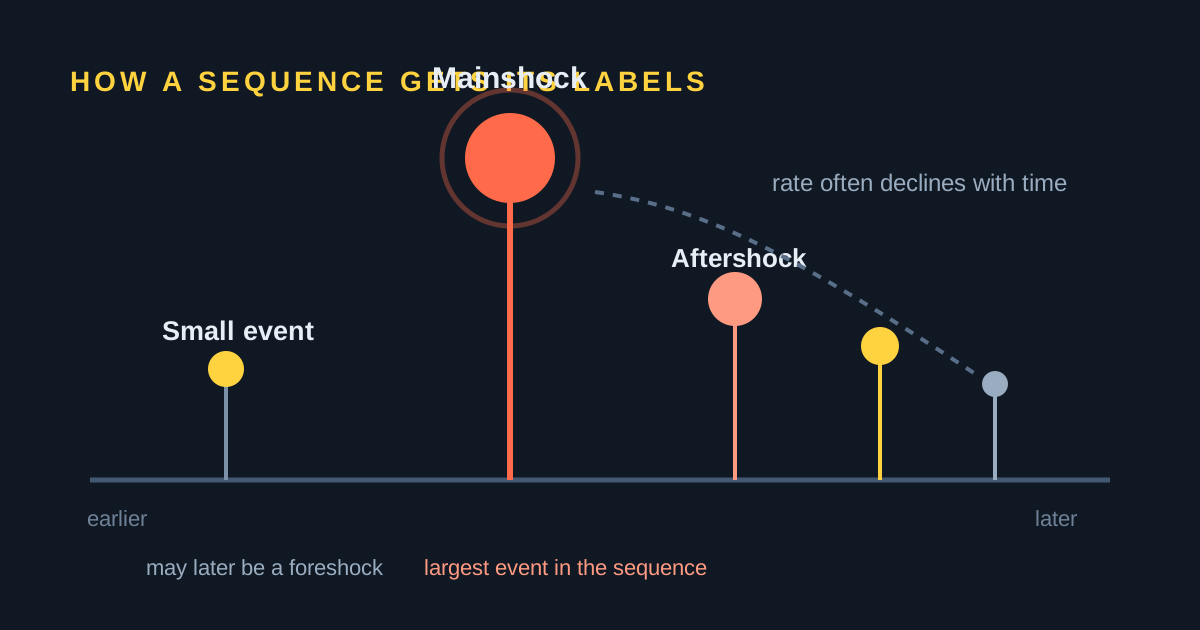
This is the honest version of a short-term forecast: statistical, updated as the sequence develops, and explicit that it cannot name a specific event. How those sequences behave, and why a cluster is not a countdown, is covered in our guide to aftershocks, foreshocks and mainshocks.
Early warning is not prediction
An early-warning system detects the first seismic waves after rupture has begun and races an alert ahead of the slower, stronger shaking. That can mean seconds of notice further away and often none at all near the epicentre. It is detection, not foresight. For how that differs from an app notification like SeismoWatch's, see notification vs early warning.
Two more red flags
Beyond the three-part test above, watch for ordinary background seismicity being presented as unusual without any baseline for the region, and for anyone asking for money or promising to reveal a secret method. Do not change your safety behaviour on the strength of an unverified prediction — and do not abandon real preparedness because one failed.
Prepare instead
Preparedness works precisely because it does not depend on knowing when. The steps below matter as much in a year with no earthquake as in a year with one.
- Learn Drop, Cover and Hold On and practise it where you actually spend time — the guidance from the Earthquake Country Alliance is the standard reference.
- Secure what can fall on you: bookcases, water heaters, wall-mounted televisions, heavy pictures over beds.
- Keep water, medication, a torch and sturdy shoes where you can reach them in the dark.
- Know your building. Unreinforced masonry and soft-storey ground floors are the known problems in most regions; ask whether yours has been retrofitted.
- Agree an out-of-area contact so family members have one number to check in with.
- Turn on your government emergency alerts and, if you live where early warning exists, its official app or broadcast channel.
What SeismoWatch can tell you
SeismoWatch shows earthquakes after they appear in the USGS, EMSC and FUNVISIS catalogues and can notify you about published events matching your area and magnitude filters — see the earthquakes today map or browse by region. It does not predict earthquakes and it is not a life-safety early-warning system. Keep your official emergency alerts switched on alongside it.
Frequently asked questions
Can earthquakes be predicted?
No. There is no accepted method that can state the time, place and magnitude of a future earthquake narrowly enough to act on and be tested in advance. Long-term hazard forecasting and post-earthquake aftershock forecasting are real and useful, but neither is a prediction of a specific event.
Can animals predict earthquakes?
No repeatable connection has been demonstrated. Anecdotes about unusual animal behaviour go back to antiquity, but they are almost always collected after the earthquake, nobody records the far more numerous days when animals behave oddly and nothing happens, and no mechanism has been established. The USGS position is that consistent, reliable pre-earthquake behaviour still eludes science.
Do moon phases or planetary alignments cause earthquakes?
Earth and ocean tides do change the stress on some shallow faults, and studies have found a small real effect on their earthquake rate. But the underlying probability on any given day is so low that raising it slightly still leaves it very low, so it cannot support a prediction. The pull of the planets at their distance is negligible by comparison.
Can artificial intelligence predict earthquakes?
Machine learning is genuinely useful for detecting small earthquakes in noisy data and speeding up analysis, but no AI system has demonstrated reliable prediction of the time, place and magnitude of major earthquakes. A model has to be tested prospectively, on earthquakes that had not happened when it was built, before its record means anything.
Is earthquake early warning a prediction?
No. Early warning detects an earthquake that has already started and races a message ahead of the strongest shaking. It can give seconds of notice further from the epicentre and often none at all directly above it.
Someone sent me an earthquake prediction. How do I check it?
Ask whether it names a time window, a place and a magnitude range, all three, narrowly enough to act on and stated before the event. Then ask whether the method has been tested over many attempts including its failures. Claims that are reworded afterwards, that cover a whole plate boundary and a whole month, or that ask for money are not predictions.
Sources and further reading
- USGS: can you predict earthquakes?
- USGS: earthquake facts and earthquake fantasy
- USGS: can animals predict earthquakes?
- USGS: can the position of the moon or the planets affect seismicity?
- USGS: the Parkfield, California earthquake prediction experiment
- USGS Fact Sheet: earthquake outlook for the San Francisco Bay region 2014–2043
- USGS: the National Seismic Hazard Model
- USGS: aftershock forecast overview
- Japan's Headquarters for Earthquake Research Promotion
- Nature: Italian seismologists cleared of manslaughter over L'Aquila
- Earthquake Country Alliance: drop, cover and hold on
- Ready.gov: earthquake preparedness